




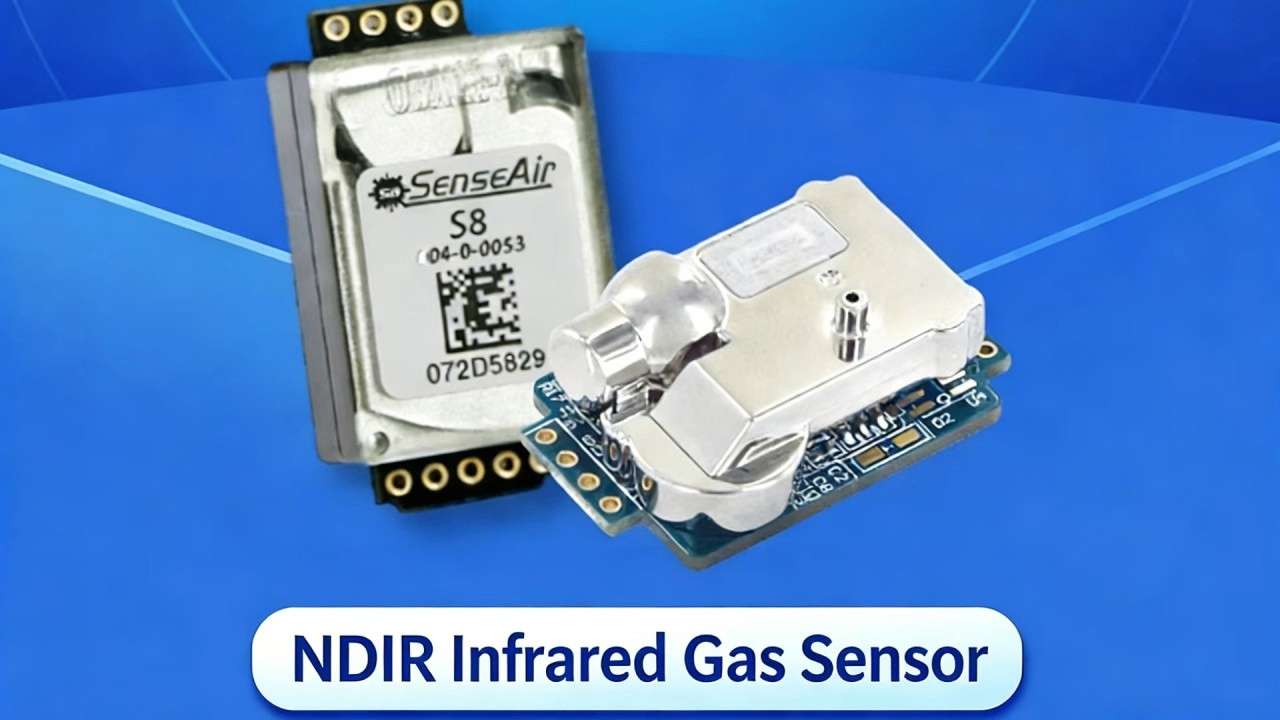
Asymmetric molecules (composed of different atoms) can absorb infrared rays at specific wavelengths. This specific absorption band is definite and standard for a certain molecule, known as the "molecular fingerprint".
Specifically, infrared radiation is electromagnetic waves within a certain waveband range. When it propagates to the surroundings and encounters a specific medium, it can be absorbed or transmitted by the medium. Symmetric diatomic molecules composed of the same atoms, such as O2, N2, H2, etc., or monatomic molecules such as He, Ne, etc., cannot generate absorption spectra. However, molecules with a dipole moment composed of different atoms can absorb radiation waves at specific wavelengths, and the technology for measuring gas concentration based on this principle is called NDIR (Non-Dispersive Infrared) technology.
With the development of infrared light sources, sensors and electronic technology, NDIR, as a fast and accurate gas analysis technology, has been widely used in gas concentration detection. For CO2 detection, the NDIR detection method is recognized as the most effective analytical means. By adopting a new type of infrared sensor, electrically modulated light source and low-power embedded system circuit, the sensor has incomparable advantages over detection principles such as electrochemistry and semiconductors in terms of volume, power consumption, performance and price.
01 Principle of NDIR Non-Dispersive Infrared
NDIR Infrared Schematic Diagram

When infrared light passes through the gas to be measured, these gas molecules absorb infrared light at specific wavelengths, and the absorption relationship obeys the Lambert-Beer absorption law.
Therefore, for a variety of mixed gases, installing a narrow-band optical filter suitable for the absorption wavelength of the gas to be analyzed in front of the sensor or infrared light source can reflect the change of the measured gas concentration through the signal change of the sensor, so as to analyze the specific components of the mixed gas.
Taking CO2 analysis as an example, the infrared light source emits infrared light with a wavelength of 1-20μm. After being absorbed by a gas chamber of a certain length, it passes through a narrow-band optical filter with a wavelength of 4.26μm. The infrared sensor monitors the intensity of the infrared light transmitted at 4.26μm wavelength, which is used to represent the concentration of CO2 gas.
02 Key Technologies of NDIR Detection
In the design of the optical system part of the sensor, in order to reduce the attenuation of the weak signal of the infrared sensor and the interference of external signals, the preamplifier circuit is also placed on the optical components, and certain electromagnetic shielding measures are taken. In order to make the gas infrared absorption signal have good resolution, the infrared light source, gas chamber and infrared detector should be set on the same optical axis in the structural design.
In addition, to make the signal sufficiently strong, elliptical or parabolic reflectors can be used. The infrared light source is powered by a constant current, and the supply voltage and current vary according to the light source used.
During operation, the sensor emits periodic infrared light according to a preset modulation frequency. The infrared light emitted by the infrared light source is incident into the measuring gas chamber through the window material. The measured gas is continuously introduced into the measuring gas chamber by the sampling gas pump. The gas absorbs infrared light at a specific wavelength, and the infrared light transmitted through the measuring gas chamber is detected by the infrared detector.
Due to the effect of modulated infrared light, the infrared sensor outputs an AC electrical signal, which is amplified by the subsequent preamplifier circuit and then passes through a high-precision amplification and rectification circuit to obtain a DC signal corresponding to the concentration of the measured gas, which is sent to the measurement and control system for processing. There is a temperature sensor inside the infrared sensor to detect the ambient temperature of its operation.
The signal of the infrared sensor is processed by the measurement and control system through software such as digital filtering, linear interpolation and temperature compensation, and then the measured value of gas concentration is given.
The following key technologies are adopted in this process:
1. Infrared Light Source and Its Modulation
New types of electrically modulated infrared light sources such as pulsIR and reflectIR have fast heating and cooling speeds. A transparent window is installed on the emission window of the infrared light source, which can ensure that the wavelength of the emitted infrared light is within a specific range, suitable for measuring conventional gases such as CO2, CO, CH4, NO, SO2 and so on. In addition, it can also prevent the influence of the external environment on the temperature of the light source.

2. Coated Gas Chamber
A structure with the gas chamber separated from the external support is adopted, and the gas chamber only needs to be fixedly installed in the center of the support structure during installation. This structural design ensures that the component is easy to load, unload and replace; at the same time, due to the separation from the external support, the influence of external conditions is further reduced, enabling the sensor to work in complex environments.
In addition, for some sensors that originally require a long gas chamber, it is very difficult to process the coating process by the previous method. After adopting this method, it becomes very easy and the cost is greatly reduced. The traditional gas chamber adopts an integrated design with the external support, which has the advantages of easy manufacture and convenient installation, but is greatly affected by the external temperature fluctuation.
3. Infrared Detector
The infrared detector is the core component of the NDIR gas sensor, and the measurement accuracy largely determines the performance of the sensor. A high-sensitivity infrared detector is used in the research, and a narrow-band interference filter for different gases is fixedly installed on its package, which can realize the measurement of different gases.

In order to ensure that the infrared detector obtains a strong and stable signal, an infrared detector directional axis can be designed. Even if the position of the infrared detector welded on the preamplifier board has a certain deviation, the sensor can ensure that it is located on the same optical central axis as the infrared light source and the gas chamber.
The signal generated by the infrared detector receiving infrared light is very weak and extremely susceptible to external interference. Therefore, a stable and reliable preamplifier circuit is the key. It is better to use a high-precision, low-drift analog amplifier circuit and a narrow-band filter circuit. The preamplifier circuit has the characteristics of high precision, small drift and fast response.
The signal output from the preamplifier is processed by the secondary amplifier circuit, which directly outputs a signal corresponding to the gas concentration and sends it to the measurement and control system. The gas concentration is obtained after nonlinear correction and compensation.
4. Sensor Measurement and Control System
In order to realize the functions of measurement, control and automatic calibration of the NDIR gas sensor, a suitable microcontroller is needed to manage the sensor. The sensor measurement and control system can directly obtain the concentration of the measured gas by collecting the infrared output signal and measuring the standard gas curve, and using the nonlinear correction algorithm.
By adopting the above technologies, the structure of the NDIR infrared gas sensor is greatly simplified compared with previous instruments, the power consumption of the instrument is also greatly reduced, and the cost of the sensor is less than 1/4 of that of previous technologies. At the same time, such sensors can realize modularization and standardization, achieve high output in a short time, are suitable for large-scale mass production, and can be widely applied.