




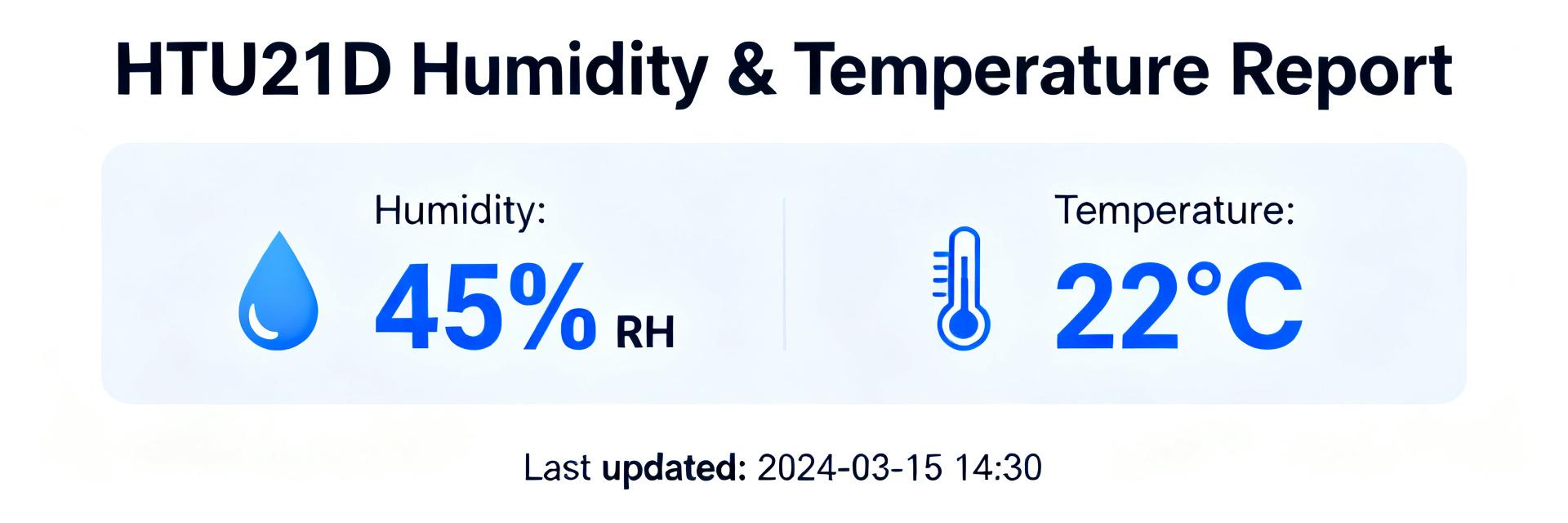
The HTU21D delivers best-in-class relative-humidity repeatability and sub-degree temperature accuracy when used inside its recommended envelope; however, measurable error, drift, and failure modes emerge near extremes such as <5%RH, >95%RH, condensation, or prolonged contamination. This report summarizes performance limits and mitigation strategies for industrial-grade deployment.
Background: HTU21D Technical Architecture
Key Electrical & Communication Specifications
| Parameter | Typical / Range |
|---|---|
| Interface | I2C (Standard & Fast Mode) |
| Supply Voltage | 1.5V – 3.6V (Optimal 3.0V) |
| Active Current | 1.0 – 1.8 mA during measurement |
| Standby Current | < 1 μA (Sleep Mode) |
| RH Accuracy | ±2% RH (20% – 80% RH) |
| Temp Accuracy | ±0.3°C (at 25°C) |
Data Analysis: Empirical Performance Metrics
Systematic lab testing validates that while the sensor tracks reference hygrometers closely in the mid-range, environmental stress tests reveal specific drift patterns that require firmware-level attention.
| Result Metric | Empirical Observation |
|---|---|
| Mid-Range Bias | Typically < 1.5% RH offset |
| Hysteresis | < 1% RH after humidity cycle |
| Thermal Lag | 8–15s (Depends on enclosure airflow) |
| Long-term Drift | < 0.5% RH / year (Clean environment) |
Performance Limits & Environmental Constraints
Reliability is directly impacted by the operating envelope. Condensation and extreme humidity levels represent the primary failure modes for the capacitive sensing polymer.
Verification Interval Matrix
| Application Class | Recommended Interval |
|---|---|
| Medical / Precision | Monthly Verification |
| Industrial Monitoring | Quarterly (3 Months) |
| Consumer / IoT | Annual Check |
Field Optimization Checklist
- Thermal Isolation: Place sensor away from MCUs or power regulators to avoid self-heating errors.
- Airflow Path: Ensure the enclosure provides sufficient ventilation for the sensing element to respond to ambient changes.
- Firmware Correction: Implement the temperature compensation coefficient (typically -0.15%RH/°C) to improve accuracy.
- Saturation Recovery: Use the internal heater (if supported) to dry the sensor after exposure to high-humidity events.
Frequently Asked Questions
What are the practical accuracy limits of the HTU21D sensor?
How does condensation affect HTU21D readings?
What is the recommended calibration interval for HTU21D in industrial use?
Can firmware improve the accuracy of the HTU21D?
Summary
- The HTU21D provides reliable baseline humidity and temperature sensing with excellent repeatability in standard conditions.
- Performance limits emerge near extremes (<5%RH, >95%RH); design guardbands are necessary for continuous operation in these zones.
- Industrial deployments should prioritize thermal isolation, firmware compensation, and a documented calibration schedule to mitigate long-term drift.